



 Medically reviewed by: dr Miloš Živković — Imedic poliklinika, Beograd.
Updated: 18.10.2026.
Hyaluronic fillers – key facts
In short
Hyaluronic acid fillers are dermal fillers based on hyaluronic acid, used to smooth wrinkles, restore lost volume and rejuvenate the face. In aesthetic medicine, they are used for lip correction, cheek contouring, nasolabial folds, under-eye hollows, chin and jawline contouring, as well as non-surgical facial lifting.
Hyaluronic acid is a natural substance already present in our body. Its key property is the ability to bind a large amount of water, giving the skin firmness, elasticity and a more youthful appearance. As the years pass, the amount of hyaluronic acid decreases, leading to volume loss, the appearance of wrinkles and changes in facial contours.
Treatment with hyaluronic acid fillers allows precise restoration of volume in areas where it has naturally been lost, with minimal recovery and results that are visible immediately after the procedure.
“When properly indicated and precisely applied, hyaluronic fillers do not change the identity of the face.”
DOCTOR’S ADVICE · DR MILOŠ ŽIVKOVIĆ
Who performs hyaluronic acid filler treatments?
If you are considering hyaluronic acid fillers in Belgrade, it is important to choose a professional clinic with experience in aesthetic medicine. Hyaluronic acid filler treatments are performed by Dr Miloš Živković, a doctor with many years of experience in aesthetic medicine and a specialised approach to individual facial analysis. Each treatment begins with an assessment of the face at rest and in movement, analysis of proportions and planning of the correction in line with the patient’s natural features.
The goal is not to change identity, but to preserve authenticity while restoring volume, harmony and freshness.
How do hyaluronic acid fillers work?
To understand why hyaluronic acid fillers are among the most commonly used dermal fillers in aesthetic medicine today, we need to understand how the face changes over time.
Ageing is not only the appearance of wrinkles. The most important change is volume loss. Fat tissue gradually decreases, facial ligaments lose firmness, and the skin becomes thinner and less elastic. The face loses support – contours become less defined, the cheeks descend, nasolabial folds become more pronounced, and under-eye hollows appear deeper.
restore lost volume in strategic facial areas
bind water and deeply hydrate the skin
provide support to ligaments and muscles
mildly stimulate collagen synthesis
The result is not just a filled wrinkle. The result is restored structure. This is exactly why hyaluronic acid fillers are not used only to “erase wrinkles”, but to restore facial proportions.
Natural-looking results as a priority
One of the most common fears patients have is: “Will I look unnatural?” The answer lies in technique and planning. When properly indicated and precisely applied, hyaluronic acid fillers do not change the identity of the face. They restore what has been lost. The goal is harmony, not exaggeration. That is why every treatment begins with an analysis of facial proportions, facial movement and structure. In modern aesthetic medicine, an isolated wrinkle is not treated – the face is treated as a whole.
What is hyaluronic acid and why is it important?
Hyaluronic acid, also known as hyaluronan, is naturally present in our body. It is found in the skin, connective tissue, eyes and joints, and its most important property is its ability to bind a large amount of water – up to 1,000 times its own weight.
Thanks to this property, young skin looks firm, elastic and hydrated. However, after our twenties, the amount of hyaluronic acid in the body gradually begins to decline. Loss of hyaluronic acid leads to reduced volume, the appearance of wrinkles and changes in facial contours.
Hyaluronic acid fillers compensate for this natural loss. By applying them to precisely defined anatomical points – the cheeks, lips, under-eye area or nasolabial folds – structural support and volume lost during the ageing process are restored.
The effect is not only visual. Hyaluronic acid contributes to skin regeneration and supports the production of collagen and elastin – proteins essential for youthful-looking skin. Since it is a substance already naturally present in the body, hyaluronic acid fillers are widely regarded as biocompatible, making the treatment safe with minimal downtime.

How long do hyaluronic acid fillers last?
Thanks to the high-quality hyaluronic acid fillers we use, which fully integrate with your tissue, the effects can last up to 24 months. The longevity of hyaluronic acid fillers primarily depends on the quality of the hyaluronic acid and the treated area.
Hyaluronic acid applied to the lips lasts 6–12 months.
In nasolabial folds, the chin and under-eye area, it lasts around one year.
In the cheeks, hyaluronic acid can last up to 2 years.
The stated duration of hyaluronic acid fillers is approximate and depends on the patient’s age, metabolism, physical activity and other factors.
When is the right time for hyaluronic acid fillers?
One of the advantages of hyaluronic acid fillers is that they can be used as soon as you notice the first wrinkles. Also, if you want to increase lip volume, shape the cheeks or define the jawline, fillers can enhance the face even before visible signs of ageing appear.
Which facial areas can be treated with hyaluronic acid fillers?
Nasolabial folds that run from the nose to the corners of the mouth,
Marionette lines that start at the corners of the mouth and extend toward the chin,
Correction of hollow or dark under-eye areas,
Lip enhancement and correction,
Lifting and contouring of the cheeks,
Facial rejuvenation – 8-point lift,
Restoration of volume in the forehead and temporal region,
Jawline and chin contouring,
Lost skin volume,
Correction of facial asymmetry,
Rejuvenation of the neck, décolletage and hands.


Hyaluronic Acid Fillers Belgrade – Price
The price of hyaluronic acid fillers depends on several factors – the area being treated, the amount of hyaluronic acid used (in millilitres), the type of product and the complexity of the correction. In aesthetic medicine, hyaluronic acid fillers are not usually charged “per area”, but most often per millilitre (ml) of the applied product. The amount needed for a visible and natural-looking result varies from person to person.
For example:
For lip correction, 0.5–1 ml of hyaluronic acid filler is usually needed
For the cheeks, around 1 ml per side is used on average
For nasolabial folds, most often 1–2 ml
With a Full Face approach, the amount may be higher, but it is planned gradually
It is important to emphasise that the quality of the product directly affects both the price and the duration of the effect. Registered and FDA-approved hyaluronic acid fillers provide greater safety, better integration into the tissue and longer-lasting results.
Because of individual differences in anatomy and the degree of volume loss, the exact treatment price is determined after an examination and treatment plan.
Hyaluronic acid fillers for lips
Hyaluronic acid fillers for lips are used to increase volume, correct asymmetry and define contours while preserving a natural appearance. If the thought of lip correction with hyaluronic acid makes you pause, you may be wondering what it actually looks like — is it only fuller lips, or something much more?
When properly applied, lips treated with hyaluronic acid fillers do not attract attention because they look “filled”, but because they are in harmony with the rest of the face. Every face has its own proportions, and the lips are an important aesthetic centre. In our clinic, we take an individual approach – analysing the relationship between the upper and lower lip, projection, contour and the dynamics of facial movement. The goal is not to create “trend lips”, but to achieve natural balance.
Whether you want a subtle increase in volume (0.5–1 ml), a more defined Cupid’s bow, correction of asymmetry or improved hydration – each treatment is planned according to anatomy and the desired result. Hyaluronic acid fillers of different densities are used – softer ones for discreet enhancement and hydration, firmer ones for clearer definition and projection. The effect is visible immediately after the treatment, while the final result appears after 10–14 days, when the hyaluronic acid fully integrates into the tissue. The duration of hyaluronic acid fillers in the lips is on average 6–12 months, depending on metabolism and the type of product.
The result? Lips remain soft, sensitive and natural to the touch — without a feeling of a “foreign body” and without loss of facial movement.
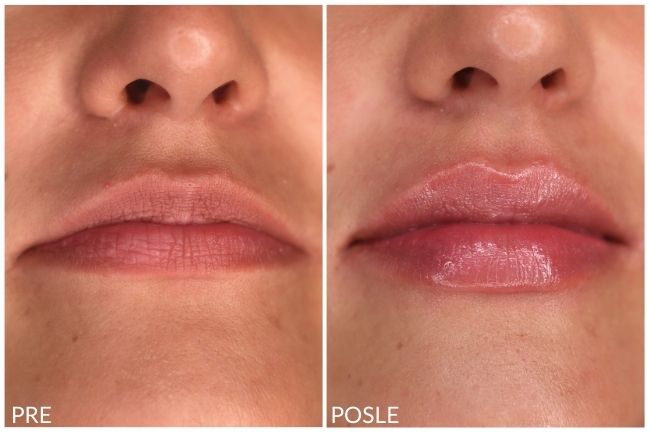
Hyaluronic acid fillers – before and after 1 ml of hyaluronic acid. Work by Dr Miloš Živković.
Discover a detailed description of the lip filler procedure, along with before-and-after photos, in the article – Lip Augmentation with Hyaluronic Acid.
Hyaluronic acid fillers for cheeks
Cheek contouring and shaping is one of the most requested hyaluronic acid filler treatments. The reason is simple – the middle third of the face plays a key role in maintaining youthful proportions. High, softly rounded cheeks create the so-called “triangle of youth” – wider in the upper part and narrower in the lower third of the face. Over time, volume is lost in the cheeks, tissue descends and facial contours change. The face may look more tired, without clear structure and without the reflection of light that gives freshness. Hyaluronic acid fillers for the cheeks work by restoring lost volume in precisely defined anatomical points. When applied into deeper layers, often using a technique in which the product is placed on the bone, the treatment can achieve:
lifting of the middle third of the face
redefinition of contours
indirect softening of nasolabial folds
improvement of overall facial balance
On average, around 1 ml of hyaluronic acid filler per side is needed for a visible effect (2 ml in total), but the amount depends on the starting condition and the desired result. The effect is visible immediately after the treatment, while the final result develops over the following 10–14 days. The duration of hyaluronic acid fillers in the cheek area can be up to 18–24 months, because denser, structural products are used.
The result? The face gains a more defined shape, better balance and a more rested expression — without overdone correction and without loss of natural appearance. Curious how your own face would look with restored cheek volume? Every treatment begins with analysis of facial proportions and individual correction planning, because the goal is not to change facial features, but to refresh and harmonise them.
Hyaluronic acid fillers for non-surgical facial lifting
One of the most popular uses of hyaluronic acid fillers in modern aesthetic medicine is the so-called non-surgical facelift. This treatment involves carefully injecting hyaluronic acid into areas where volume loss is most pronounced, as well as into points that play a key role in supporting facial ligaments. As we have already noted, when fillers are injected into strategic anatomical zones, they do not only restore lost volume. They lift facial tone from within, providing support to muscles and ligaments — an effect that visually rejuvenates the face while restoring structural harmony.
However, it is important to know that hyaluronic acid has its limitations. Ideal candidates for filler lifting are people with volume loss and mild skin laxity. In these cases, the results will be the most visible and natural-looking – facial contours are enhanced, tone is lifted and the overall expression looks fresher.
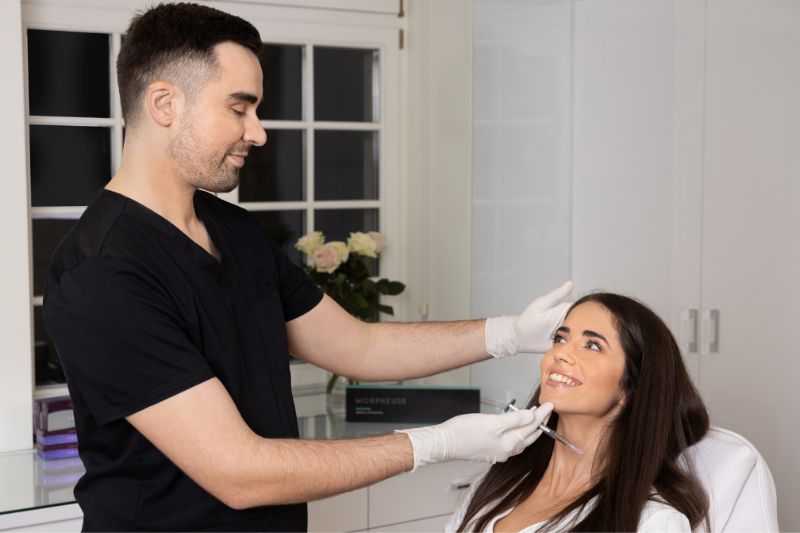
On the other hand, in patients with a pronounced excess of subcutaneous fat, especially in the lower third of the face, fillers cannot provide an adequate lifting effect. In such cases, their use must be highly selective and moderate in order to avoid an unnatural, “overfilled” appearance. That is why, in these situations, we combine hyaluronic acid fillers with advanced skin-tightening technologies such as Attiva radiofrequency and Morpheus8. These treatments effectively reduce excess fat tissue and tighten the skin, preparing the face for a possible filler correction or even fully replacing the need for fillers in certain areas.
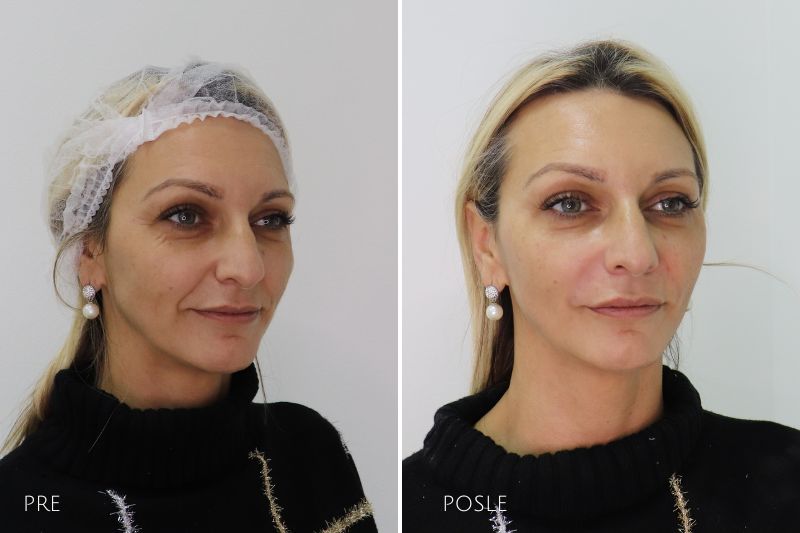
Correction of the cheeks, nasolabial folds, marionette lines and chin with hyaluronic acid. Work by Dr Miloš Živković.
Hyaluronic acid fillers for temples
Volume loss in the temples (temporal region) is one of the subtle but significant signs of ageing. Hollow temples can make the face appear narrower, more tired and less defined, even when other areas are relatively well preserved.
To explain the rejuvenation process in this area with hyaluronic acid fillers, we will mention the example of a patient (40+) who came to us because of loss of fullness in the temples and cheeks, the appearance of wrinkles and changed facial contours. After a detailed examination at rest and in movement, an individual assessment of facial proportions was made. In this case, the goal was not only to fill the hollowing, but to restore balance between the upper and middle thirds of the face.
By applying hyaluronic acid fillers to the temporal region and cheeks, the following was achieved:
restoration of temple volume
redefinition of contours
softening of shadows in the upper third of the face
a softer and more harmonious transition between the forehead and cheeks
The result was subtle rejuvenation and a fresher expression, without overdone correction.
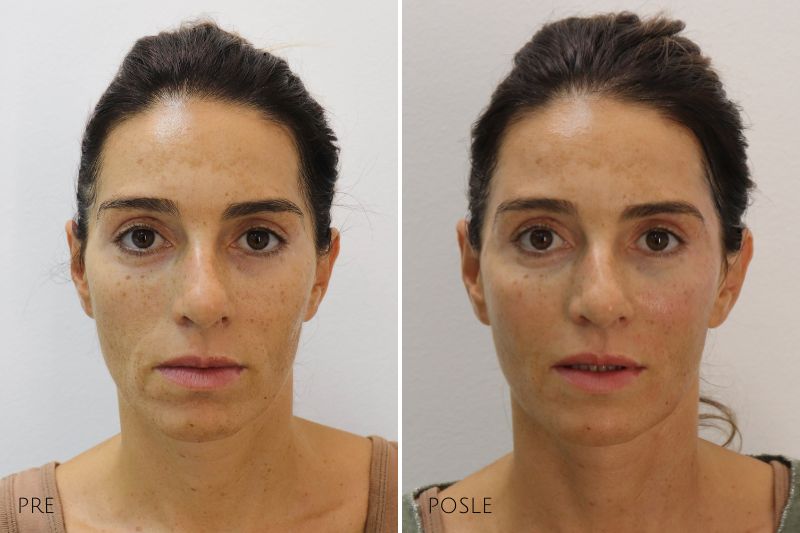
Correction of the cheeks, face and temporal region with hyaluronic acid. Work by Dr Miloš Živković.
Full Face approach with hyaluronic acid fillers
Modern aesthetic medicine no longer sees the face as a set of isolated zones. Instead of treating one wrinkle or one area, the so-called Full Face approach is increasingly used – analysis and correction of the entire facial structure with hyaluronic acid fillers.
This concept involves a detailed assessment of proportions between the upper, middle and lower thirds of the face, as well as analysis of movement and facial expressions. The goal is not simply to fill a line or emphasise a certain area, but to restore balance and structural support where volume has been lost.
In practice, hyaluronic acid fillers are applied to several strategic points, but in a precisely planned amount. We do not treat only what is most visible – we look for the cause of the change. For example, volume loss in the middle third of the face can lead to more pronounced nasolabial folds or descent of the lower third. By restoring support in key zones, the face gains a naturally lifted and rested appearance. The result of the Full Face approach with hyaluronic acid fillers is not a “dramatic change”, but subtle rejuvenation and harmonisation. The face looks more vital, the contours are clearer, but the identity remains preserved.
For patients who want comprehensive rejuvenation without surgery, this approach allows gradual, controlled and individually tailored correction. Curious what it looks like in practice? Click the link to view before-and-after photos of our patients who underwent a full face approach.
Hyaluronic acid fillers for acne scars
Problematic acne-prone skin can significantly affect self-confidence, and even when acne is successfully treated, acne scars may remain. Scars that are wide enough can be significantly improved by filling them with hyaluronic acid fillers. In our experience, the ideal combination of treatments for this problem includes CO2 laser, subcision, TCA peel and hyaluronic acid fillers.
If you still have concerns or questions and did not find the answer in the list, please check the Frequently Asked Questions page on our website.

Book your appointment
Imedic poliklinika is located at Kneza Miloša 23, II sprat, Beograd.
Book your appointment by phone: +381 60 345 0304 or +381 64 237 0707. If you are contacting us from abroad, we are also available on Viber and WhatsApp at the same number.
Medical disclaimer
This page was prepared under the professional supervision of dr Miloš Živković. The information is intended for education and a better understanding of aesthetic procedures, but it cannot replace an individual medical examination, diagnosis or treatment plan. A consultation with a doctor is necessary to assess and choose the right treatment.
Contents
Popular
Who we are

A doctor in specialist training in aesthetic, plastic and reconstructive surgery at the Faculty of Medicine in Beograd.
Since he began working in aesthetic medicine, he has regularly attended advanced training and courses, so that the techniques he uses follow current knowledge and high professional standards.
His work focuses on hyaluronic fillers, botulinum toxin, skin boosters, collagen stimulators, chemical peels, fractional CO2 laser and scar treatments.
Treatments in this article

Lip augmentation
Lip augmentation with hyaluronic acid corrects the volume, contour and symmetry of the lips. We choose the amount and technique according to lip anatomy and facial proportions.

Acne scars
Acne scars affect the skin as well as the connective and fat tissue beneath. We combine TCA peel, CO2 laser, subcision and fillers according to the type and depth of scars.

Juvéderm fillers
JUVÉDERM hyaluronic fillers are a range of products for facial volume, lips, tear troughs, skin quality and jawline contouring, with lidocaine.