



 Medically reviewed by: Dr Miloš Živković
Imedic Polyclinic, Belgrade
Updated: 19.11.2026.
Double chin removal without surgery restores a sharper angle between the chin and neck and a clearer jawline. Ultraformer III and Attiva radiofrequency tighten the skin and reduce the fat under the chin, and for smaller deposits we add lipolysis or Morpheus 8. Usually 1–3 treatments are enough, the full effect is visible after 3–4 months and lasts about a year or longer, and the price depends on the method and region.
Double chin removal – quick facts

What is a double chin?
A double chin, also called submental fullness, is pronounced fullness or laxity under the chin. In medical terms this area is called the submental region and covers the area between the chin, neck and lower jaw, along the jawline and the upper part of the neck.
In some people a double chin forms because of fat accumulating under the chin. In others it is more pronounced because of skin laxity, weaker tissue tone, genetics, the position of the chin or a less defined lower jaw. That is why a double chin does not look the same in every patient.
Sometimes it looks like a softer “cushion” under the chin. Sometimes it looks more like loose skin that blurs the line of the neck and jaw. And sometimes it is the result of a combination of both: a small excess of fat and skin that no longer has firm enough support.
A double chin can be reduced without surgery or surgically, depending on the cause: fat deposits, loose skin, a weaker jaw contour or genetics. Without surgery we reduce it with Attiva radiofrequency, Ultraformer III focused ultrasound, Morpheus 8 treatment and lipolysis, and when a weaker contour emphasises the double chin, with hyaluronic fillers for the chin and jawline. We do not perform surgical procedures such as double chin liposuction and neck lift at our clinic.
That is why double chin removal starts with an assessment: at the examination we determine whether we need to act on the fat, tighten the skin, improve tissue tone or combine several approaches.
How many treatments are needed for double chin removal?
The number of treatments depends on the method and on what is causing the double chin: Attiva usually requires 1–2 treatments, Ultraformer III one, and Morpheus 8 a series of 2–3.
| Method | Number of treatments | When the result is visible | Duration of effect |
|---|---|---|---|
| Attiva radiofrequencyfat deposit and loose skin | 1–2, the second after 4–6 months | after 4–8 weeks; full effect after 4 months | up to 18 months |
| Ultraformer IIIloose supporting layer and a small amount of fat | 1; repeated if needed after 3–6 months | builds up over 2–3 months | about 12 months |
| Morpheus 8softer skin with weaker tone | 2–3, 4–6 weeks apart | 3 months after the series | 12–18 months |
| Lipolysisa smaller, clearly defined fat deposit | in a series; the number and interval are set by the doctor | in 4–8 weeks, once the swelling subsides | removed fat cells do not return while weight is stable |
When a second treatment is needed, we decide only once the first treatment has fully developed, because collagen is produced over months. The result is maintained with one treatment a year.
In a study of 20 patients in whom radiofrequency was delivered under the skin of the chin, the satisfaction score after two months was 9–10 out of 10 [1].
Double chin removal before and after
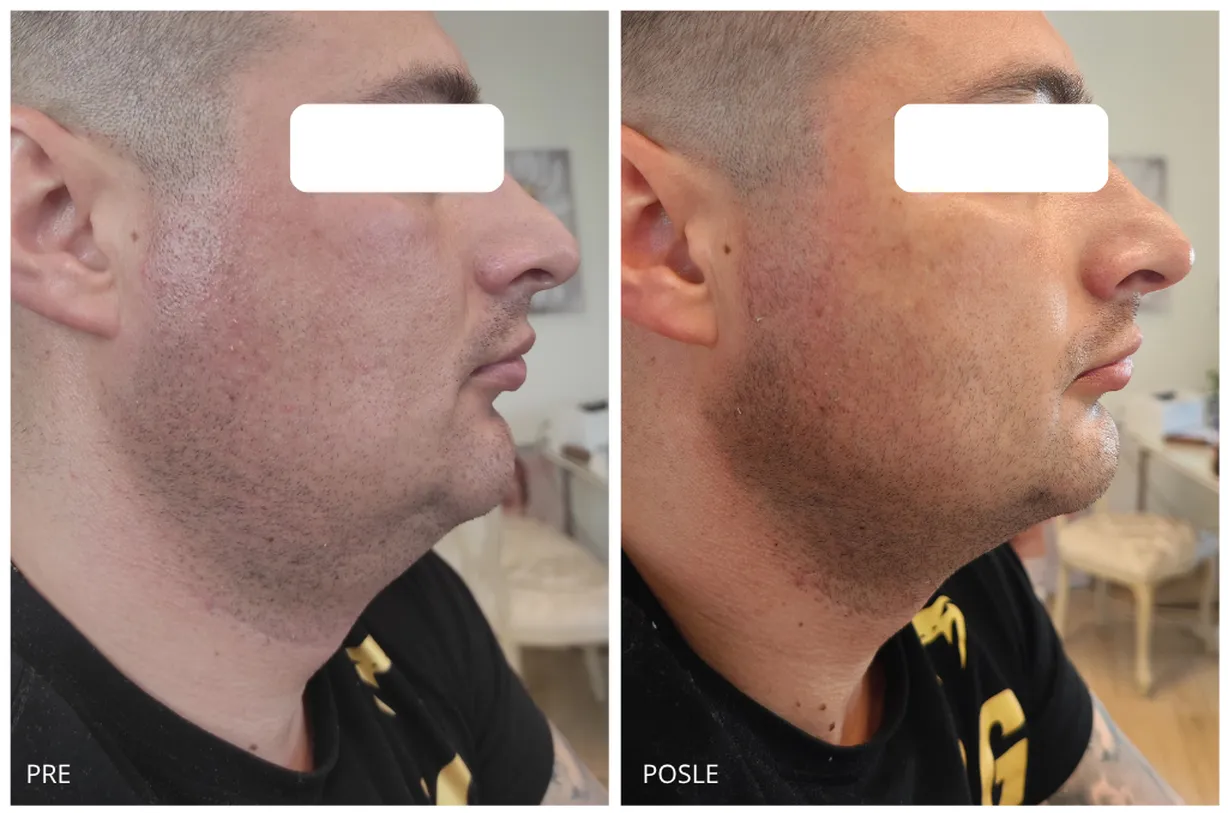
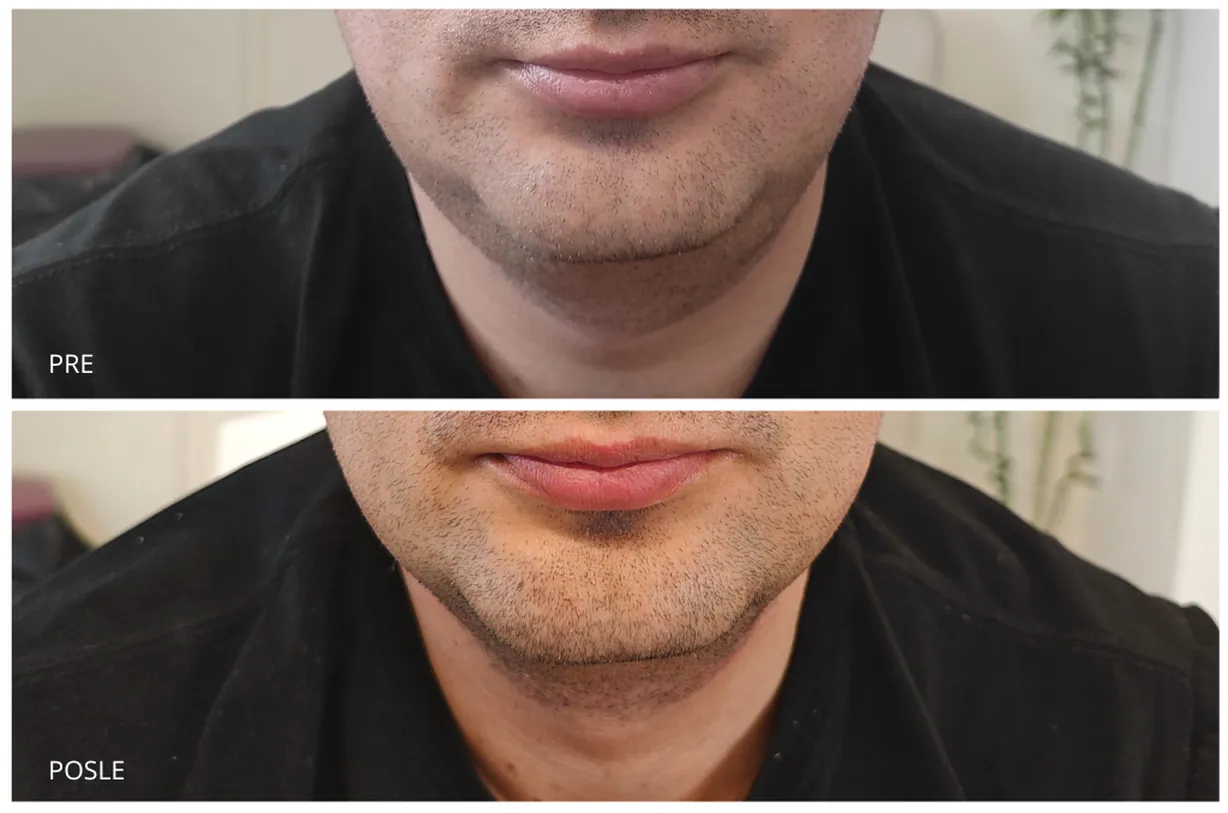
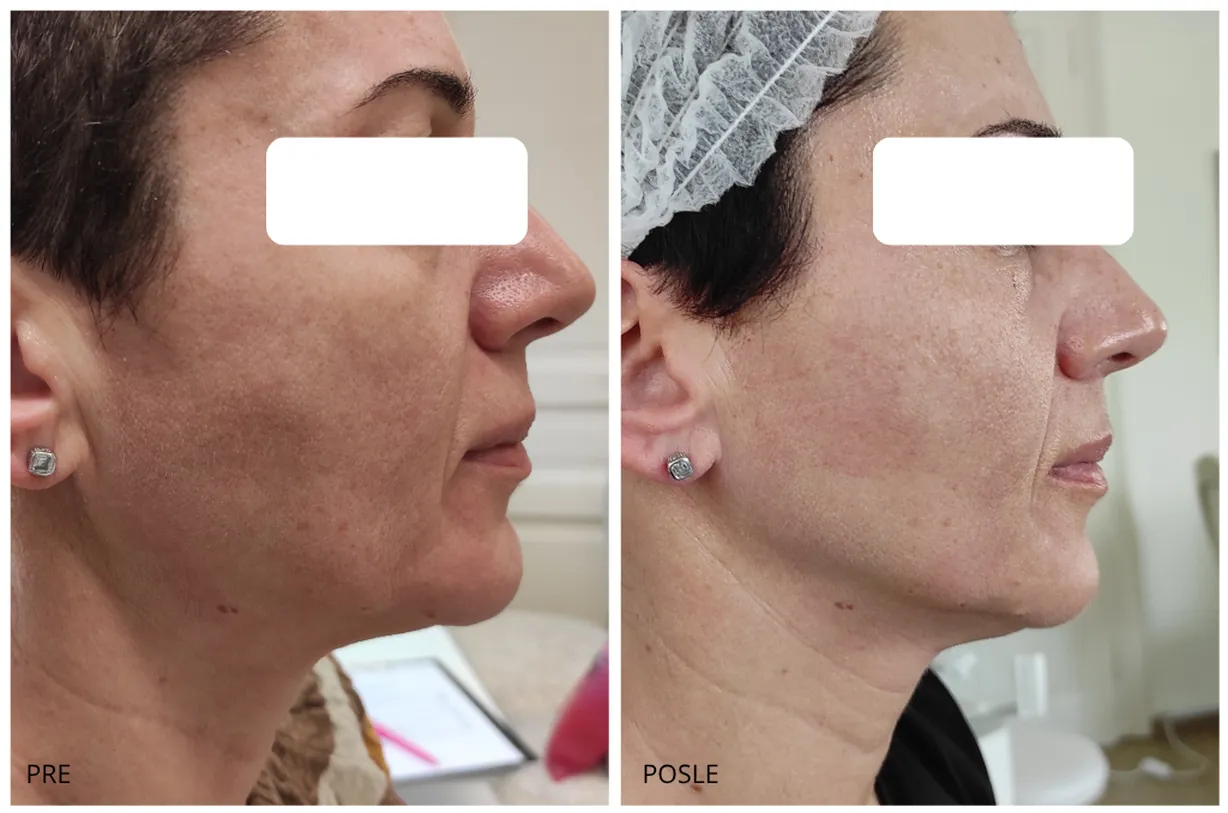
The photos show the double chin and lower third of the face after one Morpheus 8 treatment, in profile and from the front. We assess the change on photos taken under the same lighting and from the same angle.
Example from our practice
Double chin and jawline
Fullness under the chin and a transition to the neck without a clear line. After one Morpheus 8 treatment, the angle between the chin and neck is sharper and the skin under the chin is tighter, both in profile and from the front.
Example from our practice
Lower third of the face and neck
Loose skin along the jaw and under the chin, without a clear boundary towards the neck. After one treatment, the jawline is clearer and the transition from the chin to the neck is sharper.
Double chin removal – treatment price
The price is charged by method and region, and there are special prices for the double chin combined with the neck or lower face. We determine the final plan and price after the examination.
| Service | Price |
|---|---|
| Attiva radiofrequency – double chin | 36.000 RSD |
| Attiva radiofrequency – neck and double chin | 48.000 RSD |
| Attiva radiofrequency – lower face and double chin | 50.000 RSD |
| Ultraformer III – double chin | 20.000 RSD |
| Ultraformer III – lower third of the face and double chin | 60.000 RSD |
| Ultraformer III – lower third of the face, double chin and neck | 72.000 RSD |
| Morpheus 8 – lower third of the face and double chin | 24.000 RSD |
| Lipolytic for face and body | from 10.000 RSD |
What does the price of double chin removal depend on?
The total price depends on the chosen method, the number of treatments and whether only the double chin is treated or also the neck and lower third of the face. When methods are combined, each treatment is charged separately. Prices for all treatments are on our price list.
Why does a double chin form?
A double chin most often forms through a combination of genetics, fat, skin ageing and head position. In some people the main reason is genetics, so fullness under the chin is visible even when the person is not overweight. In others a double chin appears because fat accumulates in the submental region, especially if there is a tendency to store fat in the lower third of the face.
Ageing also plays an important role. Over time the skin loses collagen, elastin and firmness, so the area under the chin becomes softer and less tight. When a less defined lower jaw or a receding chin is added to this, a double chin can look more pronounced than it really is.
Head position also affects how a double chin looks. Looking down at a phone for long periods, working at a computer with the head lowered and poor posture can further emphasise skin laxity and the fold between the chin and neck.
When a double chin is not a double chin
In some patients, the fullness under the chin is caused by a receding or underdeveloped chin, not by fat. In them, the problem lies in the projection of the chin and the angle between the chin and neck.
When the chin is receding or underdeveloped, the angle between the neck and lower jaw becomes obtuse, so the soft tissue under the chin visually “merges” with the neck. The result looks like a double chin, although anatomically it is not. In such cases, treating the fat does not bring the change the patient expects, because the cause is not being treated.
The solution then lies in chin projection and defining the jawline. How we assess the profile and the relationship of the chin to the nose and lips is described on the page receding and small chin, and the treatment itself on the page chin and jawline contouring. You can see what the change in profile looks like in such patients in the gallery before and after results of chin and jawline correction.
Hyaluronic fillers do not remove fat: the chin gains forward projection and the jawline becomes sharper, so the angle under the chin is sharpened and the double chin is optically reduced. The result is visible immediately, the final look is after 10–14 days, and the effect lasts 12–18 months.
In some patients we combine both approaches: first device-based tightening of the submental region, and then defining the chin and jawline. The order depends on what contributes more to the appearance of the double chin.
When can a double chin be treated without surgery?
A double chin can be treated without surgery when the problem is mild to moderate. This usually means there is a smaller localised fat deposit under the chin, mild to moderate skin laxity or a less defined lower jaw contour.
Device-based treatments give a more pronounced response when the skin still has the potential to respond to collagen stimulation and tightening. In those cases they can firm the submental region, tighten it and give it better visual definition.
In a prospective study of 103 patients treated with microfocused ultrasound in the lower third of the face, about two thirds of patients reported improvement after 90 days, and the outcome was weaker in people with a body mass index above 30 [2]. This matches what we see in practice: device-based treatments give the most predictable result in patients with moderate findings and a stable body weight.
Expectations should be realistic. Device-based treatments can improve the appearance of a double chin, reduce the impression of laxity and firm the skin, but they cannot change the anatomy of the chin, jaw or neck.
Attiva radiofrequency for double chin removal
We choose Attiva radiofrequency when the double chin consists of both a smaller fat deposit and loose skin, with a less defined jawline. A thin cannula is inserted through a small entry point, and radiofrequency energy is delivered under the skin: the heat contracts collagen fibres, stimulates fibroblasts to produce new collagen and reduces a smaller fat deposit under the chin. The skin therefore gradually becomes firmer, and the transition between the chin, neck and lower jaw clearer.
The treatment is done under local anaesthesia and takes about 60 minutes. Afterwards, swelling, tenderness and a feeling of tightness are expected, and bruising is possible. Mild swelling lasts 10–14 days, longer than after devices that work through the skin surface, so plan your commitments with this in mind.
We choose Attiva for a small to moderate double chin. The change builds up over months: it is visible in 4–8 weeks, and final after 4 months.
Ultraformer III for double chin
Ultraformer III works with focused ultrasound and is suitable for double chin removal because in this region there is loose skin, a loosened supporting layer and accumulated fat at the same time. Ultrasound waves pass through the skin surface without affecting it and converge only at a depth chosen in advance, so the surface layer remains intact.
For a double chin we work at two depths. The 4.5 mm cartridge acts on the SMAS layer, the connective tissue and muscle layer that holds the soft tissues of the face and loosens over time, and on the fat under the chin: the heat damages fat cells, and the body removes them through the lymphatic system over the following weeks. When the SMAS contracts, the jawline becomes clearer and tissue that has descended is lifted. With the 3 mm cartridge we act on the firmness of the skin itself.
Collagen fibres contract already during the treatment, but the main part of the effect comes from the new collagen the skin produces over the following 2–3 months. One treatment is usually enough, and a second, when needed, is done 3–6 months later. The effect lasts about 12 months, so the treatment is usually repeated once a year.
When there really is a lot of skin and it gathers into folds, focused ultrasound does not solve this, and at the examination we openly recommend a surgical option.
Morpheus 8 for double chin
We choose Morpheus 8 for double chin removal when the double chin is not large, and the skin under the chin is softer, with weaker tone and less definition. Microneedles enter the skin to a set depth, and radiofrequency energy at their tips heats the tissue and triggers renewal. In an experimental study, bipolar fractional radiofrequency stimulated the formation of both new collagen and new elastin [3].
For a double chin, the value of Morpheus 8 lies in firmer skin and better tone under the chin and along the jawline; we address a larger excess of fat with other methods.
The treatment is done with numbing cream. Afterwards the skin is red, slightly swollen and tender, and the small marks from the microneedles fade within a few days. We plan 2–3 treatments 4–6 weeks apart, depending on the findings, and assess the final look three months after the last treatment.
Double chin lipolysis
When the double chin is a clearly defined fat deposit and the skin is firm and elastic, as an additional method for double chin removal we use injectable lipolysis.
A lipolytic product is injected with a fine needle directly into the fat under the chin, where it breaks down fat cells. The body gradually carries away the released fat through the lymph and blood and breaks it down further. The injections are done without anaesthesia; a brief stinging and tension are felt.
After the treatment the area swells, and the swelling lasts 3–7 days, with possible bruising and tenderness. While the swelling lasts, the area looks fuller than before the treatment – this is expected and passes.
The number of treatments and the interval are set by the doctor according to the amount of fat. The reduction becomes visible once the swelling subsides, usually 4–8 weeks from the start of the series. Lipolysis is intended for smaller deposits and its result does not compare with liposuction. When there is loose skin as well as fat, we combine lipolysis with tightening.
Can a laser remove a double chin?
Laser skin treatments do not remove a double chin. The lasers we use – fractional CO2, Erbium and Alma lasers – deliver energy into the skin, where they renew its texture, even out the complexion and reduce wrinkles and scars. The fat under the chin lies deeper, beneath the skin, so laser energy does not reach it and the double chin stays the same size.
When patients ask for laser double chin removal, they usually want a change without incisions and stitches. At our clinic this role is played by Ultraformer III, which acts with focused ultrasound on the supporting layer and fat, and Attiva radiofrequency, which delivers heat under the skin through a thin cannula. For a smaller, clearly defined fat deposit, lipolysis is an additional method.
A laser has a place in the plan when, alongside the double chin, the quality of the neck skin – texture, fine lines and complexion – also needs improving.
How do we choose the method for double chin removal?
The choice of method depends on the cause of the double chin. At the examination we assess three things separately: the amount of fat, the quality and tightness of the skin, and the contour of the lower jaw together with chin projection.
If fat dominates and the skin is good, we choose Ultraformer III. If skin laxity dominates, we choose Attiva radiofrequency for deeper tightening and better contour definition, or Morpheus 8 for firming the skin and stimulating collagen. If the fat deposit is small and clearly defined and the skin is good, lipolysis is an additional method. If the problem is in the contour, double chin treatment is complemented with hyaluronic fillers for the chin and jawline.
| Method | What it acts on | Anaesthesia | Number of treatments | Recovery | When it is not the choice |
|---|---|---|---|---|---|
| Attiva radiofrequency | deeper tissue tightening and the contour under the chin | local, with an entry point for the cannula | 1–2 | mild swelling for 10–14 days, possible bruising | a large excess of skin, pronounced platysmal bands |
| Morpheus 8 | skin quality and firmness, collagen stimulation | numbing cream | 2–3, 4–6 weeks apart | redness and needle marks, for a few days | a more pronounced fat deposit under the chin |
| Ultraformer III | the SMAS supporting layer and the fat of the double chin | numbing cream | usually 1, a second if needed | temporary redness and tenderness | skin that gathers into folds |
| Injectable lipolysis | localised fat under the chin | without anaesthesia | in a series, according to findings | swelling for 3–7 days, possible bruising | loose skin without a significant excess of fat |
| Hyaluronic fillers | chin projection and jawline | numbing cream | plan based on facial proportions | back to daily activities the same day; final look in 10–14 days | fat or loose skin as the main cause |
Do exercises and weight loss remove a double chin?
Exercises do not remove a double chin, while weight loss helps when the double chin has developed because of excess weight. Neck and chin exercises strengthen the platysma and suprahyoid muscles and can improve posture and tone, but they do not reduce fat in the submental region, because fat is not removed by local muscle work.
In people whose double chin is the result of weight gain, weight loss often brings visible improvement. However, in some patients the submental region is resistant, so fat remains even after body weight has normalised. With rapid weight loss the opposite effect can also occur: the fat decreases, but the skin stays loose, so the contour under the chin looks flabbier than before.
That is why we advise patients who are planning significant weight loss to postpone device-based treatments until their weight has stabilised.
“For a double chin without surgery, it is crucial that the skin still has firmness: then Ultraformer or Attiva tighten the skin and reduce fat at the same time, so the angle between the chin and neck returns without incisions or surgical recovery.”
DOCTOR’S TIP · DR MILOŠ ŽIVKOVIĆ
Treatment plan and possible combinations
We choose a combination in the double chin removal plan when the double chin has both a fat and a skin component. Most often we first reduce the fat and then tighten the skin, because only after the volume is reduced can we see how loose the skin really is. Ultraformer III or Morpheus 8 is then done no earlier than 4–6 weeks after the last lipolysis.
In patients in whom laxity predominates, the order is reversed: with Attiva radiofrequency we tighten the deeper layers, and with Morpheus 8 after 4–6 weeks, once the swelling has gone, we further improve skin tone and texture. We do not do Ultraformer III and Attiva on the same day, but with a 4–6 week break, and Morpheus 8 about a month after Ultraformer. In some patients one method is enough.
Treatments are not stacked on top of each other without a break, because this does not speed up the result but intensifies the tissue reaction. None of these methods changes the position of the chin or the bone structure of the jaw. When there is also loose skin on the neck and décolleté alongside the double chin, we extend the plan to the whole region, as described on the page neck and décolleté rejuvenation.
DEEPER TIGHTENING
Attiva radiofrequency
When the double chin consists of a fat deposit and loose skin, for a clearer contour.
SUPPORT AND FAT
Ultraformer III
For the supporting layer and fat under the chin, without needles.
SKIN FIRMNESS
Morpheus 8
When the skin under the chin is softer and has weaker tone.
What can you realistically expect?
After double chin removal treatment, you can realistically expect a tighter area under the chin, a clearer transition between the neck and lower jaw, firmer skin and less of a soft double chin. The most predictable results are seen in patients with a small to moderate double chin, mild to moderate skin laxity and preserved tissue quality. In some patients the change is most visible in profile, because the line of the chin and neck separates more clearly.
The result develops gradually. With device-based methods excess skin is not removed surgically; the tissue is stimulated and tightened in a controlled way, and the skin produces new collagen, so the improvement builds up over weeks and months, with the full effect after 3–4 months.
The effect of Ultraformer lasts about 12 months, Attiva up to 18 months, and Morpheus 8 12–18 months, depending on the initial condition of the skin and how fast it ages. Fat cells removed by lipolysis do not return, but the remaining ones can enlarge if body weight increases.
When is surgery the better choice?
Surgery is the better choice when there is a lot of excess skin, when platysmal bands are visible at rest or when the cause lies in the bone of the lower jaw. There are findings in which device-based treatments will not give the result the patient expects, and we talk about this openly at the examination.
A surgical approach is more appropriate when there is a large excess of skin that gathers into folds, when the tone of the neck muscles has dropped or when the deeper structures of the lower third of the face have descended. In these situations skin tightening does not address the cause, because the problem lies below the level at which the device works.
If the cause of the double chin is insufficient projection of the lower jaw or mandibular retrognathia, neither device-based treatments nor fillers change the bone structure. Such cases are treated in the field of maxillofacial surgery.
We do not perform such procedures at our clinic. Still, we believe it is fair for you to hear this before you invest time and money in a treatment that does not suit your findings.
How to prepare and when to postpone the treatment?
At the examination, tell the doctor which medicines and supplements you take. Blood thinners and certain dietary supplements increase bruising after Attiva and lipolysis. Do not stop medicines prescribed by your doctor on your own; this is decided by the doctor who prescribed them. Stop dietary supplements that thin the blood one to two weeks before the treatment, and alcohol the day before.
Also tell us whether you have had other treatments in the neck and lower jaw region in the last few months – fillers, Morpheus 8 or Ultraformer. If you have an important event coming up, plan Attiva at least three weeks earlier and lipolysis at least a week earlier.
We postpone the treatment:
-
when there is an active infection, inflammation or an open wound on the skin in the region
-
during pregnancy and breastfeeding
-
when significant weight loss is under way or planned
With chronic illnesses, healing disorders, implants in the region and a tendency to keloids, the doctor decides on the treatment at the examination.
What do the treatment and recovery look like?
The visit takes 30–60 minutes, and about 60 minutes for Attiva. We reduce discomfort with numbing cream, and for Attiva with local anaesthesia.
01
Assessment and plan. The doctor assesses the fat, the skin and the jaw contour and chooses the method.
02
Skin preparation. The skin is cleansed and photographed; numbing cream is applied, and for Attiva a local anaesthetic.
03
Performing the treatment. Ultraformer and Morpheus 8 work through the skin, Attiva through a thin cannula, and the lipolytic is injected with a fine needle.
04
Assessing the result. We compare the change on photos after 3 months, and after 4 for Attiva, from the same angle.
Recovery:
What is expected after the treatment, and when should you contact a doctor?
Swelling, tenderness, a feeling of tightness and bruising are expected. For a few days avoid intense exercise, sauna, swimming pools, harsh products and direct sun, and do not massage the area or treat it with home devices or strong active ingredients without agreeing this with the doctor.
Contact a doctor if the pain, redness or swelling increases instead of decreasing after a few days, if you develop a fever or if you notice a change in the skin or in your smile that worries you.
Possible side effects of double chin removal
Tenderness, redness, swelling and sometimes bruising are expected after the treatment. After Ultraformer they pass quickly, after lipolysis within 3–7 days, and the mild swelling after Attiva within 10–14 days. In a safety review of focused ultrasound, exactly such mild and temporary reactions were the most common, and more serious ones were rare [4].
After Attiva and lipolysis, the tissue under the chin may feel firmer to the touch for a few weeks and gradually softens on its own. Rarely, temporary numbness of the skin or short-lived weakness of lower lip movement may occur, and these resolve without treatment.
The doctor chooses the depth and energy according to the thickness of the skin and fat, and at the follow-up we check how the area is recovering.
Double chin removal – frequently asked questions
Book your appointment
Imedic Polyclinic is located at Kneza Miloša 23, 2nd floor, Belgrade.
Appointments by phone: +381 60 345 0304 and +381 64 237 0707. If you are contacting us from abroad, we are also available on Viber and WhatsApp at the same number.
Medical disclaimer
This text was prepared under the professional supervision of Dr Miloš Živković. The information on this page is meant to educate and help you understand aesthetic procedures, but it cannot replace an individual medical examination, diagnosis or treatment plan. A consultation with a doctor is needed to assess you and choose the right treatment.
Sources
Contents
Who we are
Doctor in specialist training in aesthetic, plastic and reconstructive surgery at the Faculty of Medicine in Belgrade.
Since he started working in aesthetic medicine, he has regularly attended advanced training and courses so that the techniques he uses follow the latest knowledge and high professional standards.
His work focuses on hyaluronic fillers, botulinum toxin, skin boosters, collagen stimulators, chemical peels, fractional CO2 laser and scar treatments.
You may also be interested in…
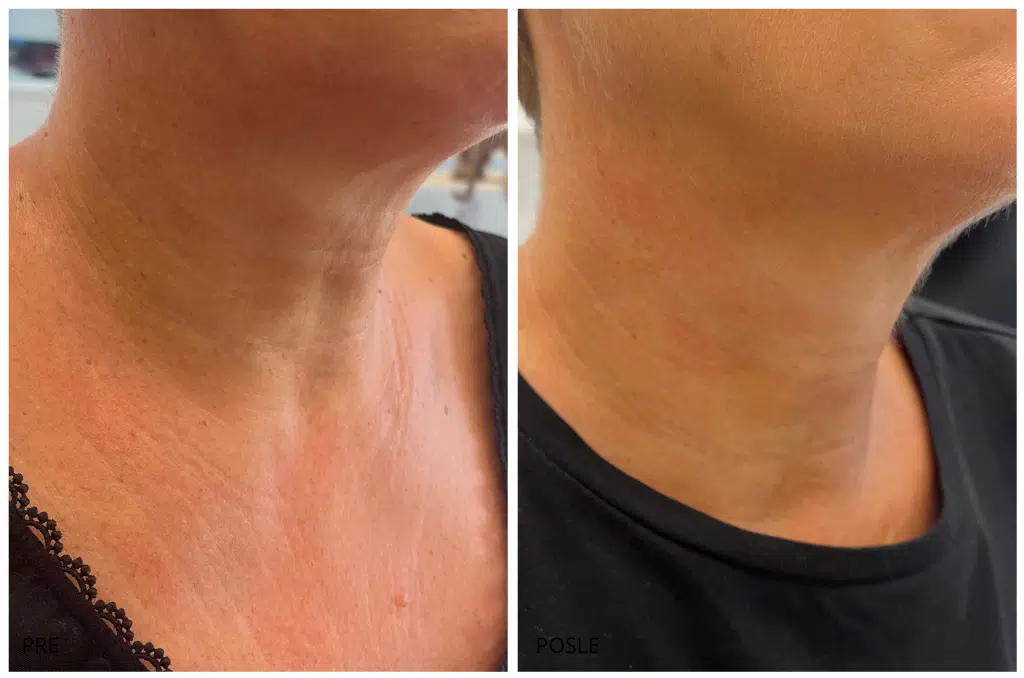
Collagen stimulators
When the skin of the neck and face needs gradual renewal of density with injections.

NIR skin tightening
For mildly loose skin, with a return to daily activities the same day.

Marionette lines
When shadows descend from the corners of the mouth towards the chin.