



 Medically reviewed by: Dr Miloš Živković
Imedic Polyclinic, Belgrade
Updated: 19.11.2026.
When redness on the cheeks and nose gets worse in the sun, in the heat or after a glass of wine, and small capillaries show through the skin, the cause lies in blood vessels close to the surface. Yellow laser, a laser that emits yellow light with a wavelength of 577 nm, heats the haemoglobin in those vessels, so they close and the redness fades. Usually 2–3 treatments are needed, about a month apart.
Yellow laser – quick facts

What is the Yellow laser and how does it work?
The Yellow laser is a medical laser that emits yellow light with a wavelength of 577 nm and is used for facial redness, rosacea, dilated capillaries, angiomas and certain pigmentation changes. At Imedic Polyclinic we use the Asclepion PRO Yellow device made by the German manufacturer Asclepion Laser Technologies from Jena, so in searches it also appears as the “Pro Yellow” or “Asclepion Yellow” laser.
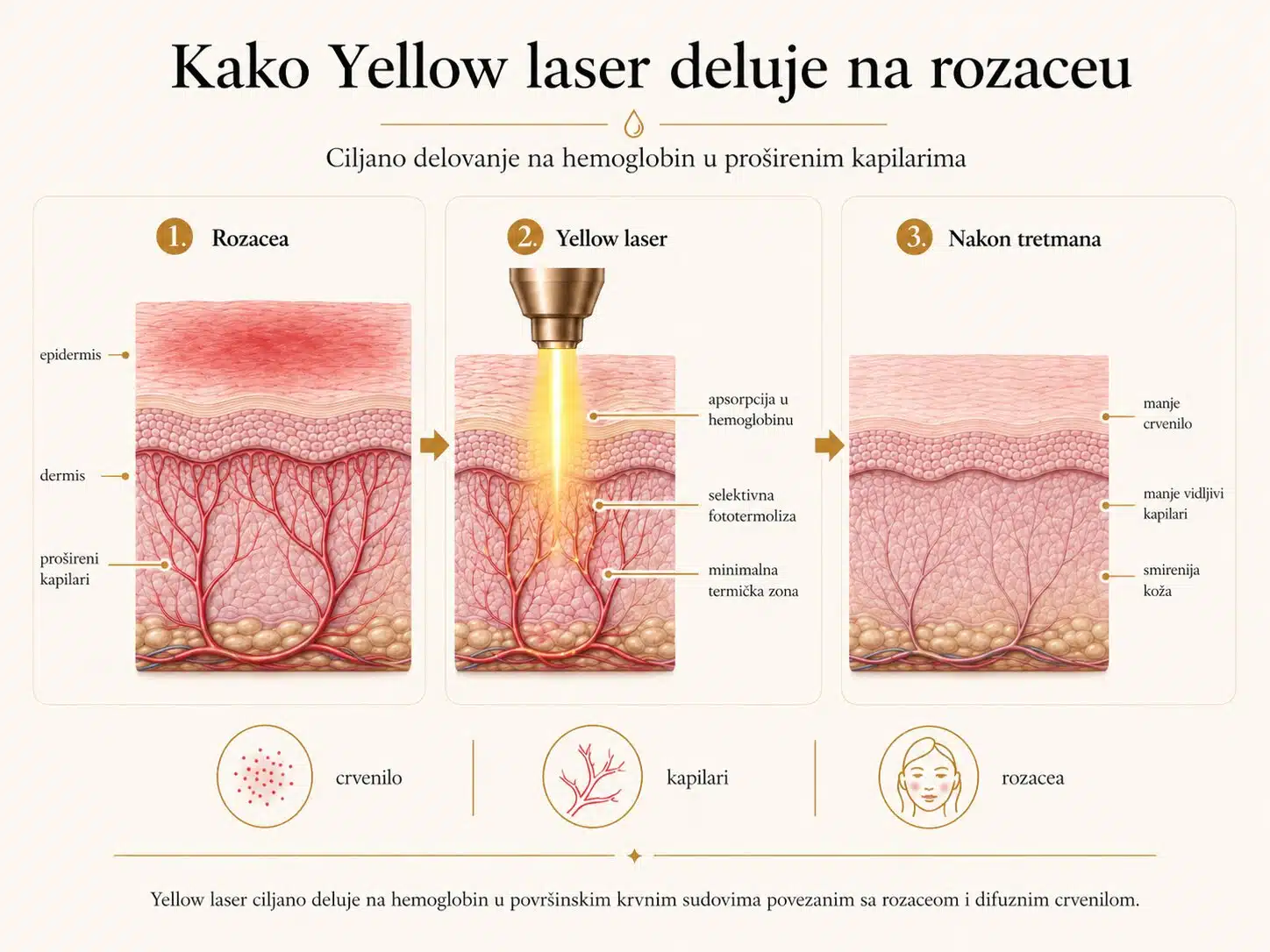
The 577 nm wavelength matches one of the absorption peaks of haemoglobin, the pigment in blood that gives blood vessels their red colour. That is why yellow light targets small vessels close to the surface while heating the surrounding skin less. Unlike IPL devices, which emit a broad spectrum of light, this is a single-wavelength laser, so we list it among our laser treatments.
A review of published studies on the 577 nm laser showed that it is used mostly for redness, rosacea and small blood vessels, and less often for pigmentation changes, usually as part of a broader plan [1].
How does the Yellow laser work on the skin?
When the light reaches a small capillary, the energy is converted into heat in the haemoglobin. The vessel wall is damaged in a controlled way, the vessel closes and the body breaks it down over the following weeks, so the red line or redness gradually fades.
With pigmentation changes the target is melanin, the pigment that creates dark spots. In melasma and dark post-inflammatory marks, dilated capillaries are almost always present beneath the pigment, so the yellow laser acts on both layers of the problem, with gentler settings.
How many Yellow laser treatments are needed?
For all indications, the plan usually includes two to three Yellow laser treatments, about four weeks apart. The exact number depends on how pronounced the redness, capillaries or spots are and how the skin responds after the first treatment.
| Indication | Number of treatments | Interval |
|---|---|---|
| Facial rednessDiffuse redness that is easily triggered. | 2–3 | about a month |
| RosaceaRedness and capillaries, alongside the therapy prescribed by the doctor. | 2–3 | about a month |
| Dilated capillaries and couperoseThin red lines on the cheeks and nose. | 2–3 | about a month |
| Angiomas and spider veinsSmall red dots and star-shaped vessels. | 2–3 | about a month |
| Red marks after acneRed marks after acne has settled. | 2–3 | about a month |
| Melasma and post-inflammatory marksAlongside home therapy and sun protection. | 2–3 | about a month |
In our practice we assess the result before each next visit, so with milder changes the series often ends after the second treatment. In a study of 95 patients treated once a month, 86.3% of patients with facial redness had an improvement of more than 50%, after an average of 1.8 treatments. In dilated capillaries, 62.5% of patients had such an improvement, after an average of 3.6 treatments [2].
Yellow laser – before and after
The change after the Yellow laser builds up from treatment to treatment: redness fades, capillaries become less visible and the complexion calmer. That is why we compare photos under the same lighting and from the same position. With dilated capillaries the difference is visible straight away: the capillary examples below were photographed immediately after one treatment, which is why the skin is still a little red – this is expected and passes.
Cheek and jaw – rosacea
Diffuse redness and rosacea on the cheek and along the jaw. After three treatments, one a month, with topical therapy and daily sun protection, the redness is visibly paler and the skin more even.
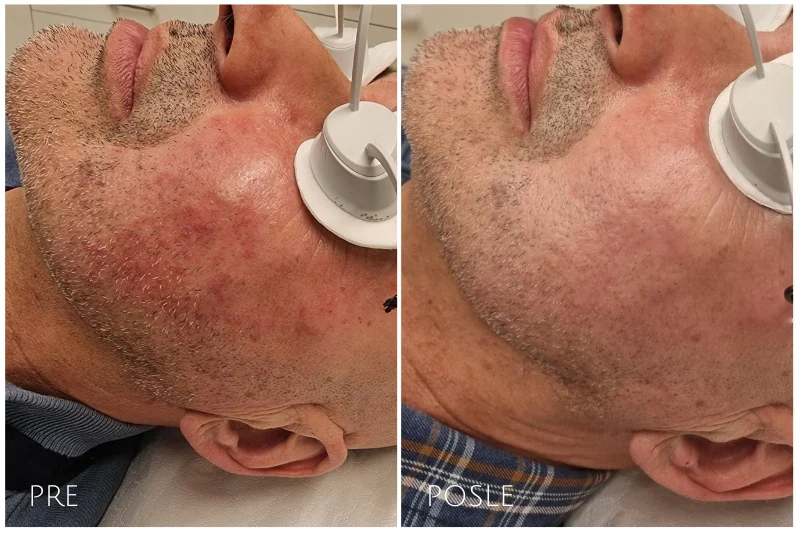
Rosacea, cheek and jaw · after 3 treatments · Work by Imedic Polyclinic doctors
Capillaries on the nose
A dense network of dilated capillaries on the tip and side of the nose. In the photo taken immediately after one treatment, the thin red lines are no longer visible; the nose is still slightly red from the treatment itself.
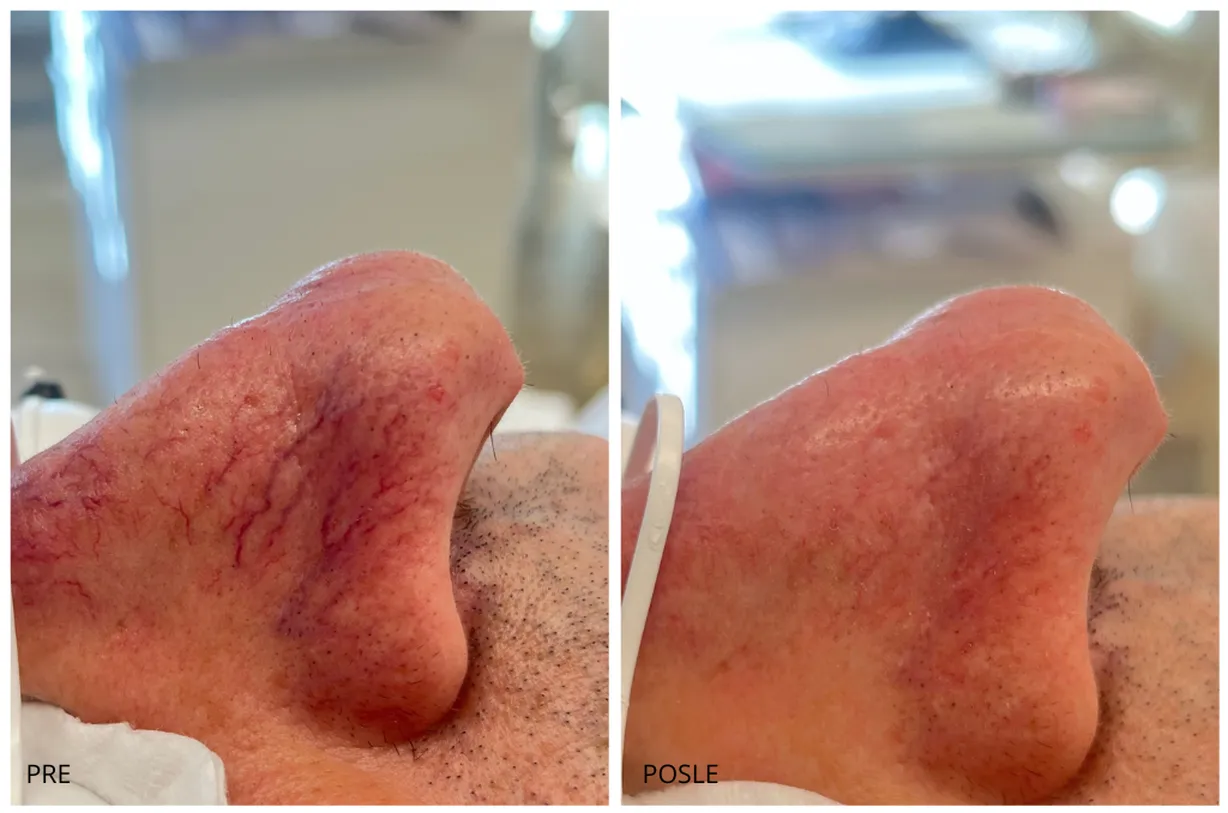
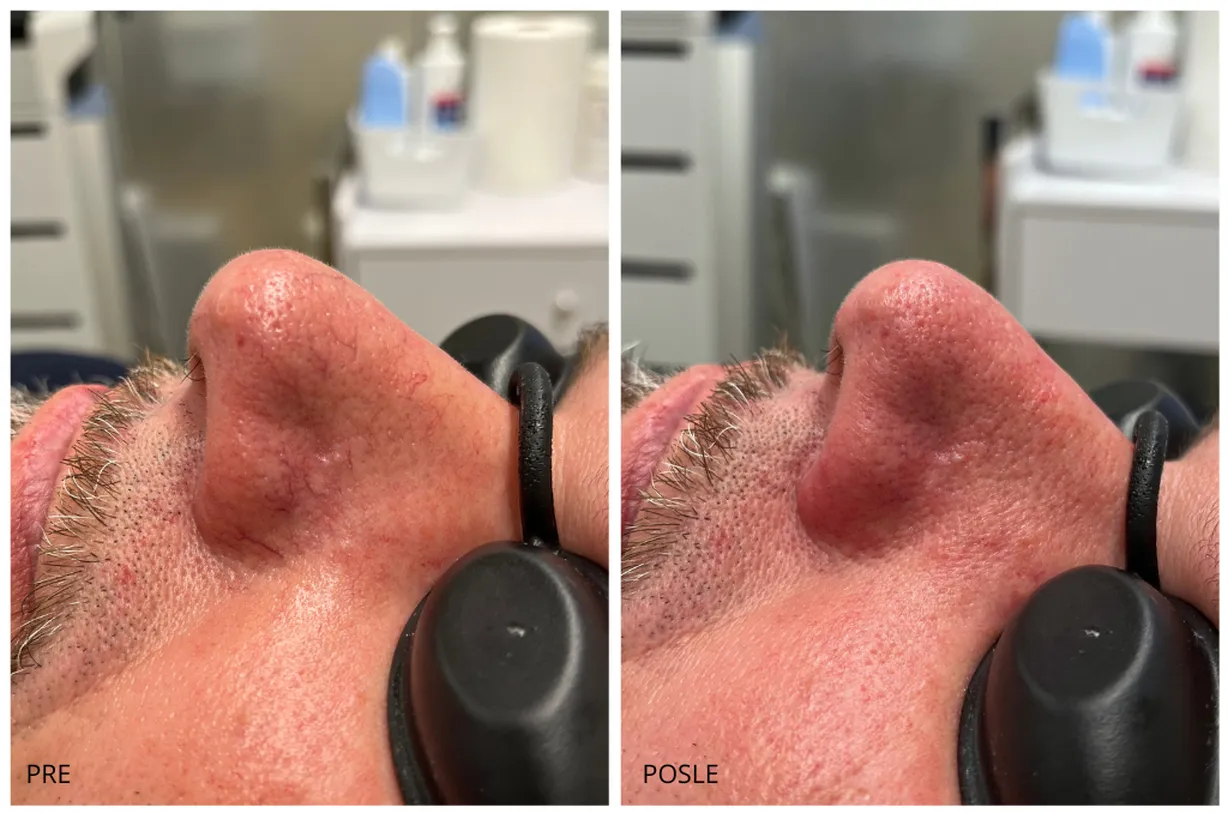
Capillaries on the nose · 1 treatment, photo immediately after · Work by Imedic Polyclinic doctors
Capillaries on the nostril
Small capillaries along the edge of the nostril. This is a spot where capillaries are often visible even in people without rosacea; after just one treatment the nostril is clear.
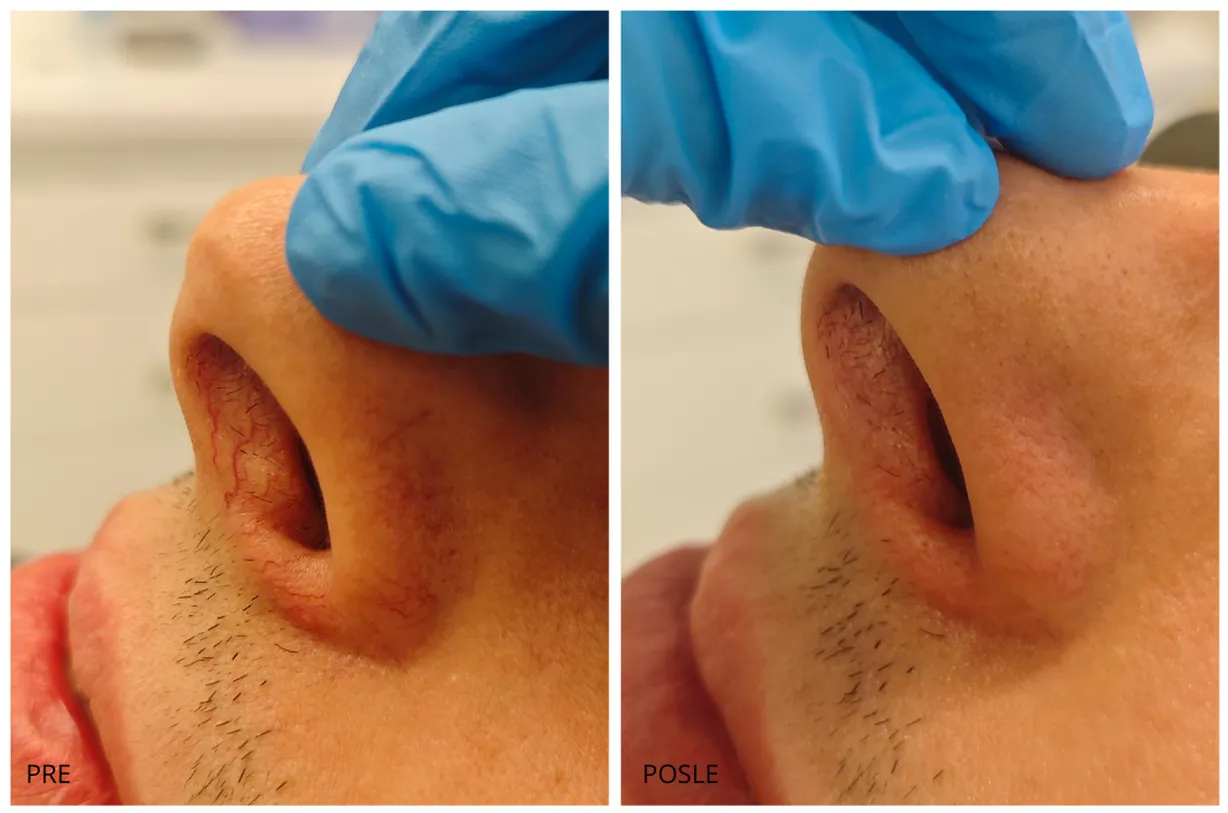
Capillaries on the nostril · 1 treatment, photo immediately after · Work by Imedic Polyclinic doctors
Capillaries on the cheek
Prominent, branching capillaries on the cheek, next to the nose. Immediately after one treatment, the branching vessels are no longer visible and the cheek has an even colour.
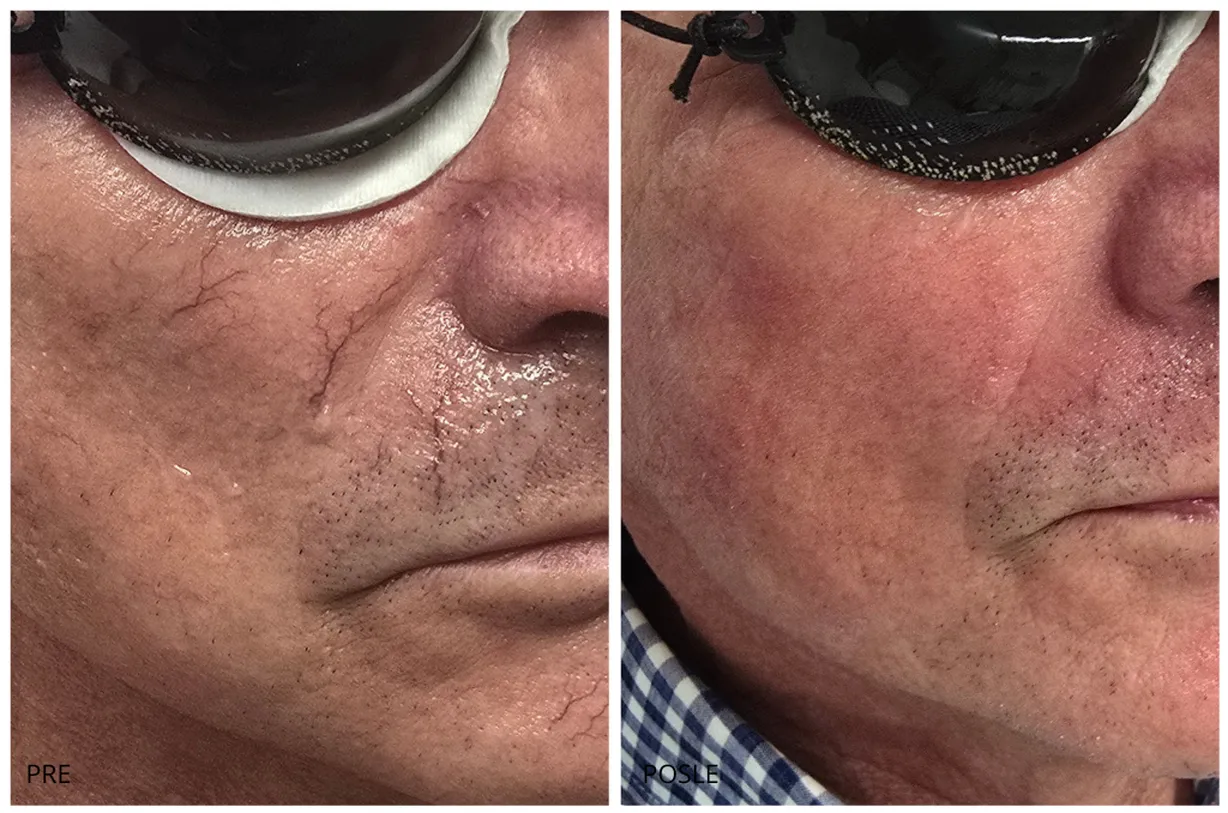
Capillaries on the cheek · 1 treatment, photo immediately after · Work by Imedic Polyclinic doctors
Small capillaries on the lower face
Thin, barely visible capillaries on the lower cheek and chin. In the photo immediately after one treatment, the small vessels are no longer visible, and the mild redness at the treated site is a temporary skin reaction.
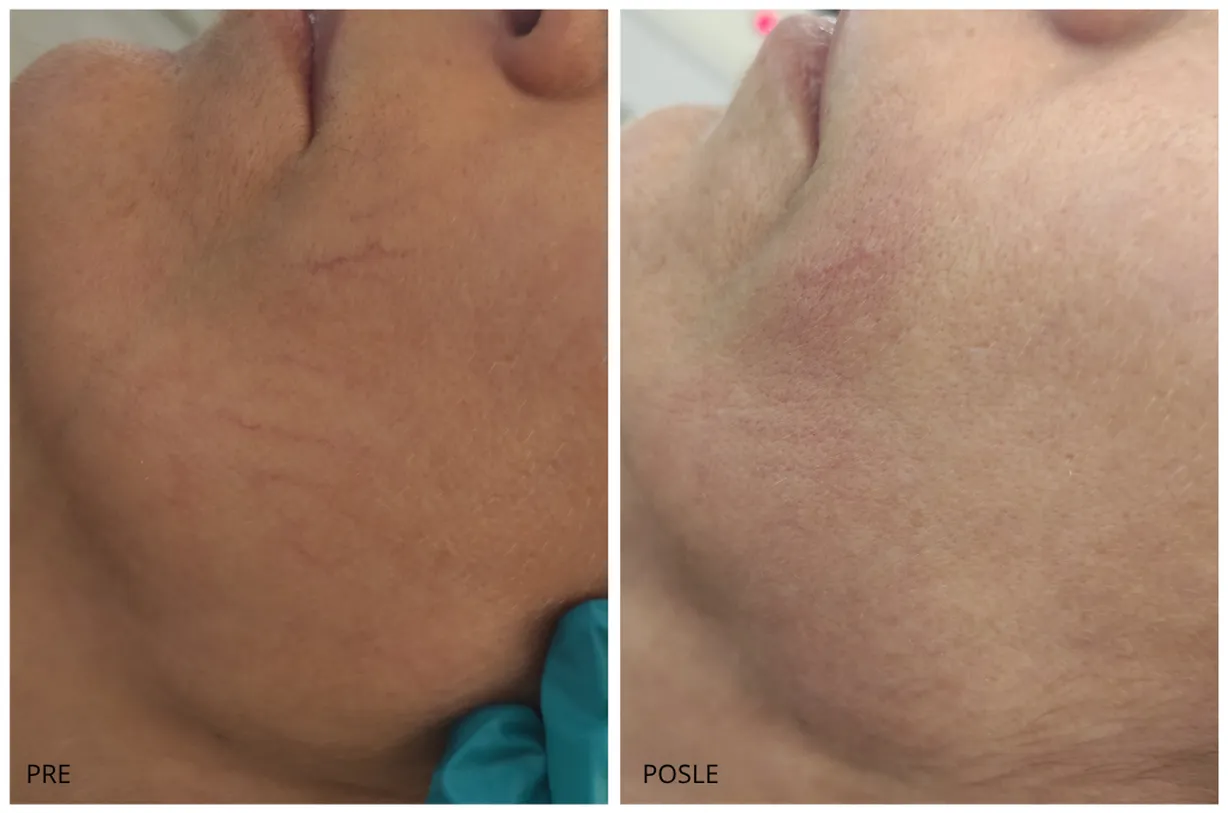
Small capillaries, cheek and chin · 1 treatment, photo immediately after · Work by Imedic Polyclinic doctors
Yellow laser – treatment price
The price of the Yellow laser is calculated per region and per treatment: cheeks, the whole face, or capillaries on the nose and mid-face.
| Service | Price |
|---|---|
| Cheeks (redness, rosacea, capillaries) | 17.500 RSD |
| Full face (redness, rosacea, capillaries) | 20.000 RSD |
| Removal of capillaries on the nose | 5.000 RSD |
| Removal of capillaries on the nose and central face | 12.000 RSD |
What does the price of a Yellow laser treatment depend on?
The total amount depends on the size of the region and the number of treatments in the plan, because each visit is paid separately. The complete overview is on our price list.
Redness, capillaries or spots? At the consultation we assess the skin and suggest the regions and number of treatments, so you know the cost of the plan in advance.
What is the Yellow laser used for?
We use the Yellow laser for facial redness, rosacea, couperose, dilated capillaries, spider veins, angiomas and red marks after acne, and, alongside home therapy, for certain dark spots and melasma. It helps most when redness is easily triggered by sun, heat, cold, stress, alcohol or spicy food.
Rosacea and facial redness
In rosacea, redness returns and worsens with the same triggers, and the skin can look constantly “inflamed”, even though there is no classic infection. The laser calms the vascular component – the small vessels that cause the redness – so the complexion becomes calmer and more even. Rosacea is a chronic skin condition, so the laser is combined with the therapy and skincare prescribed by the doctor; more about the condition itself and its treatment is on the page Rosacea.
Dilated capillaries and couperose
Dilated capillaries appear as thin red lines on the cheeks, nose, chin and around the nose, sometimes individually and sometimes with diffuse redness or couperose. The Yellow laser works best on small superficial capillaries. For more prominent or deeper vessels we also use the long-pulsed Nd:YAG laser.
Angiomas and spider veins
Angiomas are small, bright red dots on the skin, and spider veins are small vessels that spread out like rays from a single point. Both respond well to the yellow laser, often after just one or two treatments.
Red marks after acne
After acne has settled, red marks often remain on the skin and do not fade for months. The Yellow laser acts on the dilated vessels in those spots, so the redness fades faster. Depressed scars are a different problem, and for them we choose other treatments.
Post-inflammatory marks and melasma
In melasma and dark marks after inflammation or acne, the yellow laser is an essential part of the plan, because beneath the spots there are almost always dilated capillaries that keep the darkening going. It is done alongside home therapy and sun protection, and the complete treatment of melasma is described on the page Melasma removal. More about other types of dark spots is on the page Hyperpigmentation.
“The yellow laser targets redness and small capillaries, so it gives the most when they are the main skin problem. That is why, before treatment, we assess what dominates and only then choose the settings.”
DOCTOR’S TIP · DR MILOŠ ŽIVKOVIĆ
When are Yellow laser results visible and how long do they last?
With redness and capillaries, the first change is visible once the skin calms down and any scabs have gone, and we assess the result about a month after the treatment, before the next visit. Treated capillaries gradually disappear, and the redness fades from treatment to treatment.
In a study of 98 patients treated every 4 weeks, 83.9% of patients with rosacea with redness and capillaries had an excellent or very good result, after an average of 2.7 treatments. When the nose was also affected, the result was somewhat weaker [3].
In rosacea, the laser helps calm the symptoms: the redness is weaker and the skin reacts less to triggers. Rosacea is chronic, so we do a maintenance treatment when needed. In melasma and dark spots, the change develops more slowly and depends on home therapy and sun protection.
Is the Yellow laser treatment painful?
The treatment is usually well tolerated and does not require anaesthesia: you feel mild stinging, warmth or a brief “snapping” on the skin, and the cooling system softens it. With sensitive skin, rosacea and prominent capillaries the sensation can be somewhat stronger.
After the treatment the skin is warm and slightly red, similar to after a short time in the sun, and this settles the same or the next day.
When is the Yellow laser done?
We perform the Yellow laser in the colder part of the year, from autumn to early spring, while UV radiation is weaker. We do not do it in summer, on tanned skin or on darker skin types, because then there is a higher risk of the skin darkening at the treated site.
We do not treat tanned skin, or irritated, inflamed or damaged skin, or skin immediately after aggressive treatments, because the skin must be calm for the work to be precise and safe.
With rosacea and redness, maintenance also matters: triggers such as heat, alcohol, strong sun, stress and spicy food can still cause redness. That is why the result is more stable when the laser is combined with proper skincare and avoiding known triggers.
Treatment plan and possible combinations
We choose the Yellow laser when redness, rosacea, small superficial capillaries and angiomas are in the foreground, and in melasma, where it acts on the capillaries beneath the spots. It does not treat the cause of rosacea, but it calms its symptoms, so we combine it with therapy and skincare.
It can be combined with Dye VL and Nd:YAG lasers, chemical peels, topical therapy and skin boosters, even in the same visit. For deeper and more prominent capillaries we choose the long-pulsed Nd:YAG, and when redness and spots are equally pronounced, Dye VL.
REDNESS AND PIGMENT
Dye VL laser
When redness and pigmentation changes appear at the same time.
VISIBLE CAPILLARIES
Capillary removal
For capillaries on the cheeks, nose and chin, couperose and spider veins.
SPOTS AND COMPLEXION
ClearLift laser
For dark spots and an uneven complexion, often in the same plan as the yellow laser.
How to prepare and when to postpone the treatment?
For two weeks before the treatment, avoid sunbathing, tanning beds and self-tanning products, because we do not treat tanned skin. For a few days before the treatment, do not use peels, acids or retinoids, so that the skin is calm.
At the consultation, tell us about any therapy you are taking, especially medicines that increase the skin’s sensitivity to light, as well as previous laser and aesthetic treatments in the region. If you are having the treatment before an important event, book it at least a week earlier, because of possible redness and scabs.
We postpone the treatment:
-
when the skin is tanned, recently sun-exposed or sunburnt,
-
with irritated, inflamed or damaged skin and immediately after aggressive treatments,
-
with an active infection or open wounds in the treatment area,
-
during therapy that increases sensitivity to light, until the doctor has assessed it.
In pregnancy and breastfeeding, and with chronic illnesses, the doctor assesses individually whether the treatment is justified.
What do the treatment and recovery look like?
The whole visit takes 30–45 minutes, and the treatment is done without numbing cream.
01
Assessment and plan. We assess whether redness, rosacea, capillaries, angiomas or spots dominate, because the settings are adjusted differently for each change.
02
Skin preparation. We cleanse the skin, apply a contact gel if needed, and protect the eyes with goggles.
03
Performing the treatment. We move the handpiece over the region and deliver short pulses of yellow light, while cooling the skin.
04
Assessing the result. We assess the change about a month after the treatment, before the next visit; a follow-up is arranged if needed.
Recovery:
What is expected after the treatment, and when should you contact a doctor?
Redness, warmth, mild swelling, small scabs and temporary darkening of treated capillaries are part of the normal reaction and go away on their own within a few days.
Contact a doctor if you notice blisters or pus, if the redness spreads instead of fading after the first few days, or if a dark spot at the treated site does not fade even after several weeks.
Possible side effects of the Yellow laser treatment
Serious complications after Yellow laser treatment are rare when the settings are adjusted to the skin and the change. Temporary reactions are common: redness, warmth, mild swelling and small scabs.
Less often, temporary darkening of the skin occurs at the treated site, which is why we do not treat in summer, on tanned skin or on darker skin types. In a study of 30 patients with dilated capillaries, 2 patients had such darkening, and it disappeared within a month and a half [4]. That is why we choose the settings according to skin type, and sun protection after the treatment is mandatory.
The eyes are protected with goggles during the procedure, and when the risk is greater than the expected benefit, we postpone the treatment or choose another one.
Yellow laser – frequently asked questions
Book your appointment
Imedic Polyclinic is located at Kneza Miloša 23, 2nd floor, Belgrade.
Appointments by phone: +381 60 345 0304 and +381 64 237 0707. If you are contacting us from abroad, we are also available on Viber and WhatsApp at the same number.
Medical disclaimer
This text was prepared under the professional supervision of Dr Miloš Živković. The information on this page is meant to educate and help you understand aesthetic procedures, but it cannot replace an individual medical examination, diagnosis or treatment plan. A consultation with a doctor is needed to assess you and choose the right treatment.
Sources
Contents
Who we are
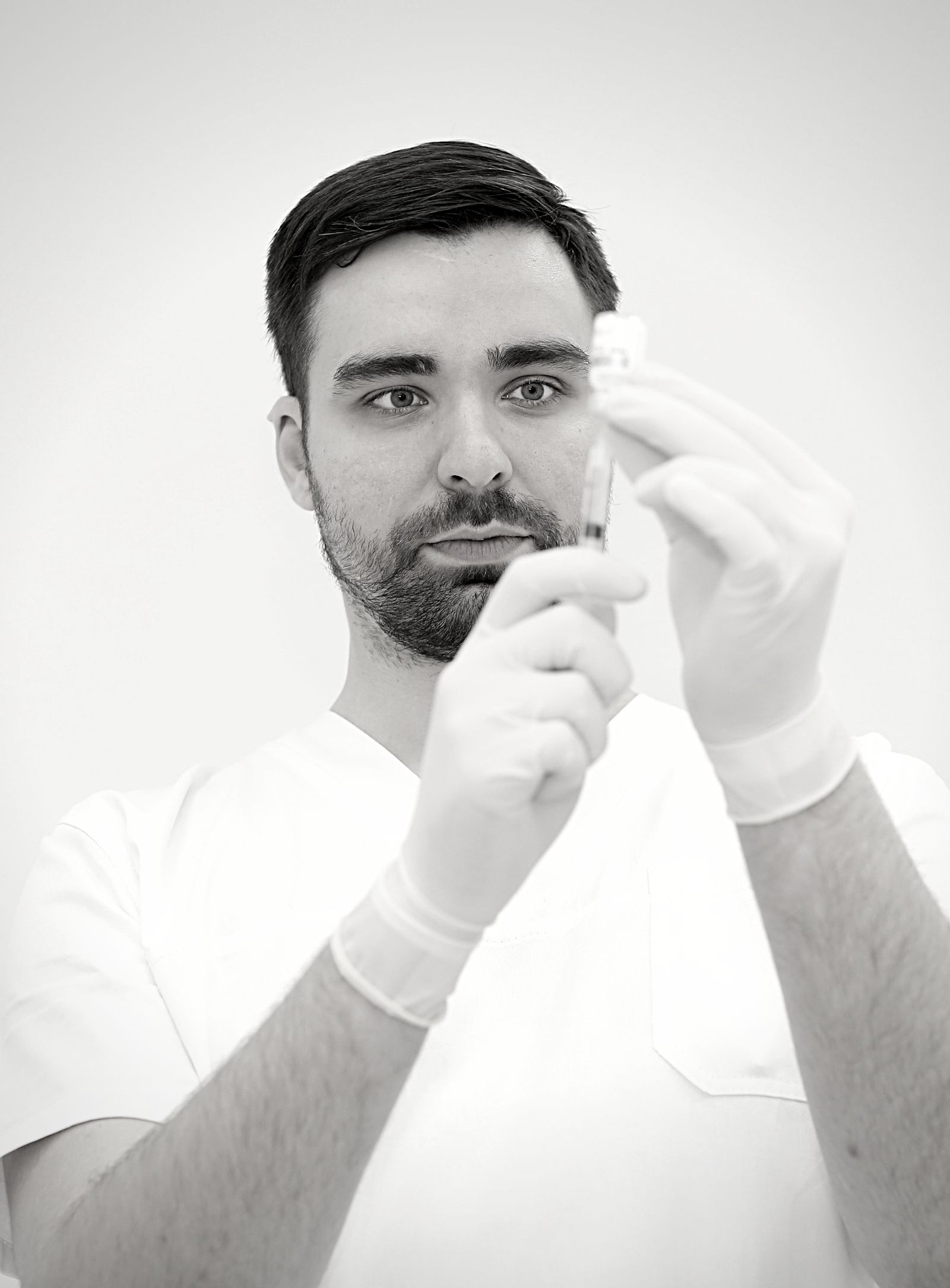
Doctor in specialist training in aesthetic, plastic and reconstructive surgery at the Faculty of Medicine in Belgrade.
Since he started working in aesthetic medicine, he has regularly attended advanced training and courses so that the techniques he uses follow the latest knowledge and high professional standards.
His work focuses on hyaluronic fillers, botulinum toxin, skin boosters, collagen stimulators, chemical peels, fractional CO2 laser and scar treatments.
You may also be interested in…

ClearSkin laser
When acne and oily skin have not yet settled, before working on redness.
NIR skin tightening
When the skin needs gentle tightening and a more rested look, without needles.

Mesotherapy
For a radiant, fresh complexion with nourishing cocktails in the skin.