



Aesthetic and anti-ageing medicine has made significant progress in all areas, whether we are talking about surgical or non-surgical rejuvenation methods. What was unimaginable a few decades ago can today be achieved with a single treatment with hyaluronic fillers or Botox. To choose the right procedure or combination of treatments that will achieve the desired result while keeping a natural look, we need to understand the ageing process in detail. Otherwise, there is a risk that the result will be short-lived, inadequate and aesthetically unsatisfying.
Understanding how ageing works and what it does to the face is a prerequisite for successful rejuvenation.
The first signs of facial ageing appear in the mid-twenties. How fast and how much the face ages depends on external and internal factors, and the usual effects and signs of ageing are:
- Soft tissue under the skin (muscles, fat and connective tissue) descends because of gravity and weakening ligaments.
- The volume of the tissue under the skin decreases – fat is absorbed and muscles become thinner.
- The forehead becomes longer as the hairline recedes.
- The ears and nose become longer as the connective tissue that supports the cartilage weakens. The nose also looks bigger because the position of the maxilla (upper jaw) changes.
- The structure of the skin changes and wrinkles appear.
- The structure of the facial bones changes.
- The contours of the face change, creating shadows on the face, while the youthful glow fades.
The overall effect of these processes is what we mean by facial ageing.
Left: daughter, 26 years old. Right: mother, 64 years old.
Ageing is a process that involves changes in all facial structures, including the skin, fat pads, ligaments, muscles and bones.
The inverted triangle of youth
Left: the triangle of youth (high cheekbones, full cheeks, a firm jawline). Right: the inverted triangle (loose skin, flat cheeks, double chin).
In youth the face is clearly defined, with prominent contours. It is characterised by high cheekbones, full cheeks and a firm jawline. This is called the triangle of youth. Fat pads in the face are evenly distributed, and certain regions have plenty of them – the forehead, temples, cheeks and the areas around the eyes and mouth. With ageing, fat loses volume, shrinks and descends, so these previously full and rounded regions sink, creating hollows and wrinkles. As a result, the skin itself loses its natural support and begins to sag. As fat is redistributed, other parts of the face gain fat. The lower part of the face around the chin and jaw loses its definition and takes on a “baggy” look.
Skin ageing
Skin ageing: 1. Wrinkles and fine lines. 2. Loose skin in the cheekbone and cheek area. 3. Excess skin along the lower jawline.
Young skin is soft, smooth, well hydrated and firm. However, as we age, skin loses its ability to regenerate quickly. The amount of collagen and elastin decreases, and the sebaceous glands become less active. These processes show on the skin surface as the first expression lines on the face that form between the eyebrows and around the eyes. Because the facial muscles work constantly and the same expressions are repeated, the expression lines become etched deeper and deeper into the skin. At the same time, the skin increasingly loses its elasticity and its ability to return to its original state, so over time the lines become static and deeply etched. Fine lines and wrinkles are also linked to the harmful effects of external factors: sun, wind, cigarette smoke and others.
Besides wrinkle formation, ageing also shows as sagging and a loss of firmness and radiance of the skin. Facial ageing differs from person to person because, apart from genetics, lifestyle plays an important role.
Ageing and changes in fat tissue
Loss of facial fat: 1. Hollow under-eyes 2. Loss of fullness in the cheeks 3. Lines around the nose and mouth 4. Sagging jowls 5. Double chin
Fat pads lie beneath the skin surface in the so-called subcutaneous layer, but also in a deeper layer of the face, under the muscles. They provide volume and keep the facial contours defined. With ageing, fat pads shrink and descend. As a result, the face changes its contours and the skin sags because it loses support. Hollows form in the upper regions of the face. Here we primarily mean the area around the eyes, the temples, forehead and cheeks. In the lower part of the face, fat accumulates, so the chin and jaw lose their definition and the skin begins to sag.
Over time, the upper part of the face looks increasingly hollow and “deflated”, while the lower part looks increasingly shapeless and heavy compared with the upper part.
Ageing and changes in facial muscles
Ageing of facial muscles: 1. Lines between the eyebrows and around the eyes 2. Loss of contour and fullness of the cheeks 3. Sagging jawline
Beneath the layers of skin and fat lies the layer of facial muscles. These muscles are very active, and every movement – smiling, frowning, speaking or chewing – involves them. Constant muscle movement leaves traces on the skin surface. In youth the skin produces enough elastin and collagen, so it quickly returns to its original state and no wrinkles form. Over time, with the same movements repeated and the skin less able to regenerate, the first wrinkles appear. Another effect of muscle ageing is that the muscles weaken. This makes the face sag further, which is why it often looks tired and drawn. The first wrinkles usually appear between the eyebrows in one’s thirties. These are the so-called frown lines – two vertical lines that form from frowning and wrinkling the forehead.
Ageing and changes in bone
Ageing of facial bone: 1. Loss of forehead bone (hollows, wrinkles). 2. Loss of bone around the eyes 3. Loss of jaw bone (sagging lower face)
Bones are the foundation of the face. Muscles, fat pads, tendons, connective tissue and skin all lie on the bones. With ageing, facial bone mass is lost, which changes the contours and dimensions of the face. The eye sockets become larger, the under-eye hollows deepen and the jawline loses its definition as jaw bone mass recedes.
For an overview of treatments, see facial rejuvenation options.
Treatments in this article

Hyaluronic fillers
Hyaluronic fillers restore lost volume and facial structure – for the lips, cheekbones, under-eyes, wrinkles and a non-surgical lift, with a plan based on a facial analysis.

Aesthetic treatments in your twenties
Aesthetic treatments in your twenties most often address acne and acne scars, thin lips, cheekbones and unwanted hair – alongside healthy habits and skin care.
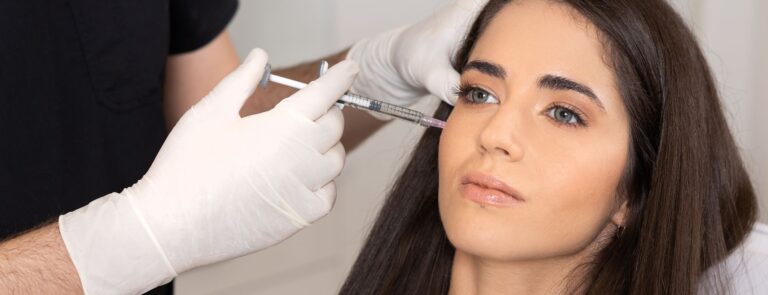
Cheekbone shaping with fillers
Cheekbone shaping with fillers restores volume and support to the middle third of the face, improves its contour and can indirectly soften under-eye hollows and nasolabial folds.

About the author
Dr Miloš Živković
Aesthetic medicine doctor at Imedic Polyclinic in Belgrade. He writes or medically reviews the articles on this site before they are published.
Medical disclaimer: This content was prepared under the professional supervision of Dr Miloš Živković. It is informative and educational and is meant to explain the options of aesthetic medicine to patients. It does not replace an individual medical examination, diagnosis or treatment plan, because the choice of treatment is always made after the doctor’s examination and assessment.
Book your appointment
Imedic Polyclinic, Kneza Miloša 23, 2nd floor, Belgrade